Understanding Transmission Line Failures in Power Grids
Imagine you are driving home during rush hour. Suddenly, the main highway bridge in your city is closed. Everyone diverts to the side roads. At first, it seems manageable. But as more cars pile onto the alternative routes, those smaller streets get jammed. Then, if it is a really unlucky day, one of those side roads also gets blocked. The traffic mess snowballs until the entire city comes to a standstill.
That same story plays out in our power grids. Instead of cars, it is electricity rushing through high-voltage transmission lines. This is what engineers call a cascading transmission line failure.
To understand how a small disturbance can grow into a large blackout, let us walk through the stages of what happens inside the power grid network.
Normal Grid Operation
The grid operates with electricity flowing across many transmission lines. Each line has a safe carrying capacity, just like roads have speed limits. To keep the system safe, protective devices called relays continuously monitor the lines.
These relays are like traffic officers stationed along every major road. If a bridge is about to collapse under too much weight, or if there is a sudden accident, the officer immediately shuts that road down to protect people from disaster. In the grid, the relay does the same: it senses an abnormal condition and disconnects the transmission line from the system, keeping equipment from being damaged and preventing a dangerous fault from spreading.
The Initial Disturbance
One transmission line fails, perhaps due to a storm, overheating, or equipment malfunction. The relay protecting that line detects the problem and disconnects it almost instantly. The flow of electricity does not stop—it reroutes through neighboring transmission lines.
Now those neighbors must carry more than they were designed for. Think of it as all the traffic from a closed highway pouring onto side streets. The cars still get through, but the side streets begin to strain under the volume. In the grid, electricity likewise flows through the remaining transmission lines, and these lines suddenly feel the pressure of the extra flow of electricity.
Dependent Failures Begin
If one of those neighboring lines becomes overloaded, its relay will also trip to protect equipment. This second failure was not random. The second failure is dependent on the first—it happened because of the first outage.
This is the point where cascading begins: a domino effect where each relay trips another line as the overload shifts through the system.
Escalation
With each trip, fewer paths remain to supply electricity to the consumer. The burden shifts again and again, and even faraway parts of the power grid feel the strain. In the worst case, this chain reaction can grow into a regional blackout—the kind that makes headlines.
Illustration
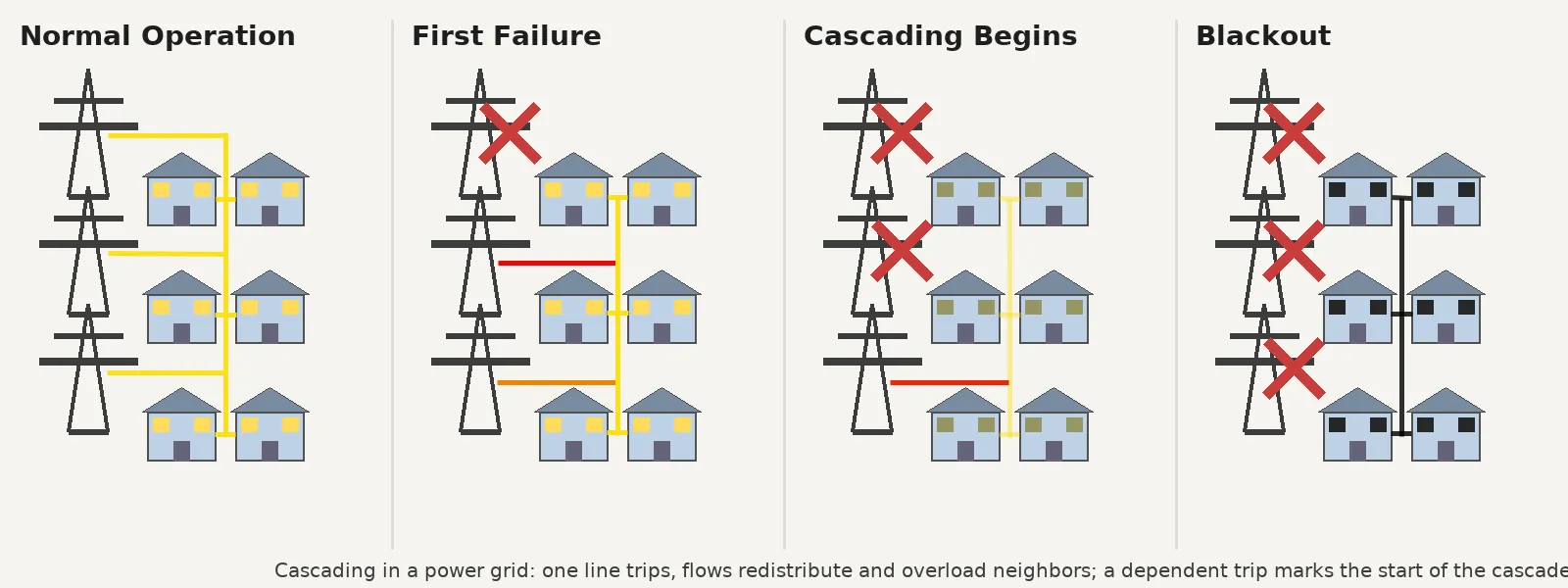 A single line failure reroutes power through its neighbors, which can overload and trip in turn — the domino effect at the heart of a cascading blackout.
Why Cascading Matters
Most major blackouts reported in the news—such as the U.S. Northeast blackout of 2003, or events in India, Italy, South America, and most recently Spain-Iberia—were cascading failures. They did not begin with an earthquake that destroyed the system all at once. They began with a single line, a single relay trip, a single event. The rest was the domino effect.
Cascading is what makes power grids both fascinating and fragile. One event might stay local and harmless, or under the wrong conditions, ripple into a chain reaction that darkens entire regions.
This is why power grid operators prepare for contingencies. The greatest danger is rarely the first failure; it is what happens after. And in a world where power grids are becoming larger and more complex, keeping that chain reaction under control is becoming even harder.
Terminology
📦 What is a Relay?
A relay is like a smart security guard for the power grid. It constantly checks the “health” of a transmission line—how much electricity is flowing, whether there is a short circuit, or if the line is overheating. If something looks dangerous, the relay instantly signals a circuit breaker to open and disconnect that line. This quick action prevents equipment damage.
Note: Figures in this post may have been generated with the help of AI.