Who actually runs the power grid?
You flip a switch. The light comes on. Somewhere, roughly a tenth of a second earlier, a generator a hundred miles away pushed a little harder to make that possible.
That sentence sounds like a metaphor. It isn’t. Electricity can’t really be stored at grid scale, so the power you’re using right now was generated moments ago, and every second of every day, somebody is making sure that the amount being produced matches the amount being used, across millions of homes and thousands of power plants, all at once.
Who is that somebody? It turns out the answer is not one person or one company. It’s a layered cast of operators, utilities, generators, and regulators, each with a different job. This post is a tour of who does what, told by following a single electron from a power plant to your kitchen lamp.
The journey
Let’s start with the physical path. A power plant, say, a natural gas plant in central Texas, spins a turbine, which spins a generator, which pushes electricity out onto high-voltage transmission lines. Those lines carry the power at hundreds of thousands of volts over long distances. At a substation near your town, transformers step the voltage down. Smaller distribution lines carry it through neighborhoods. A final transformer on a pole outside your house drops it to 120 volts. It enters your wall. You turn on the lamp.
That’s the physical story. The organizational story is more interesting, because at every step of that journey, a different entity is in charge.
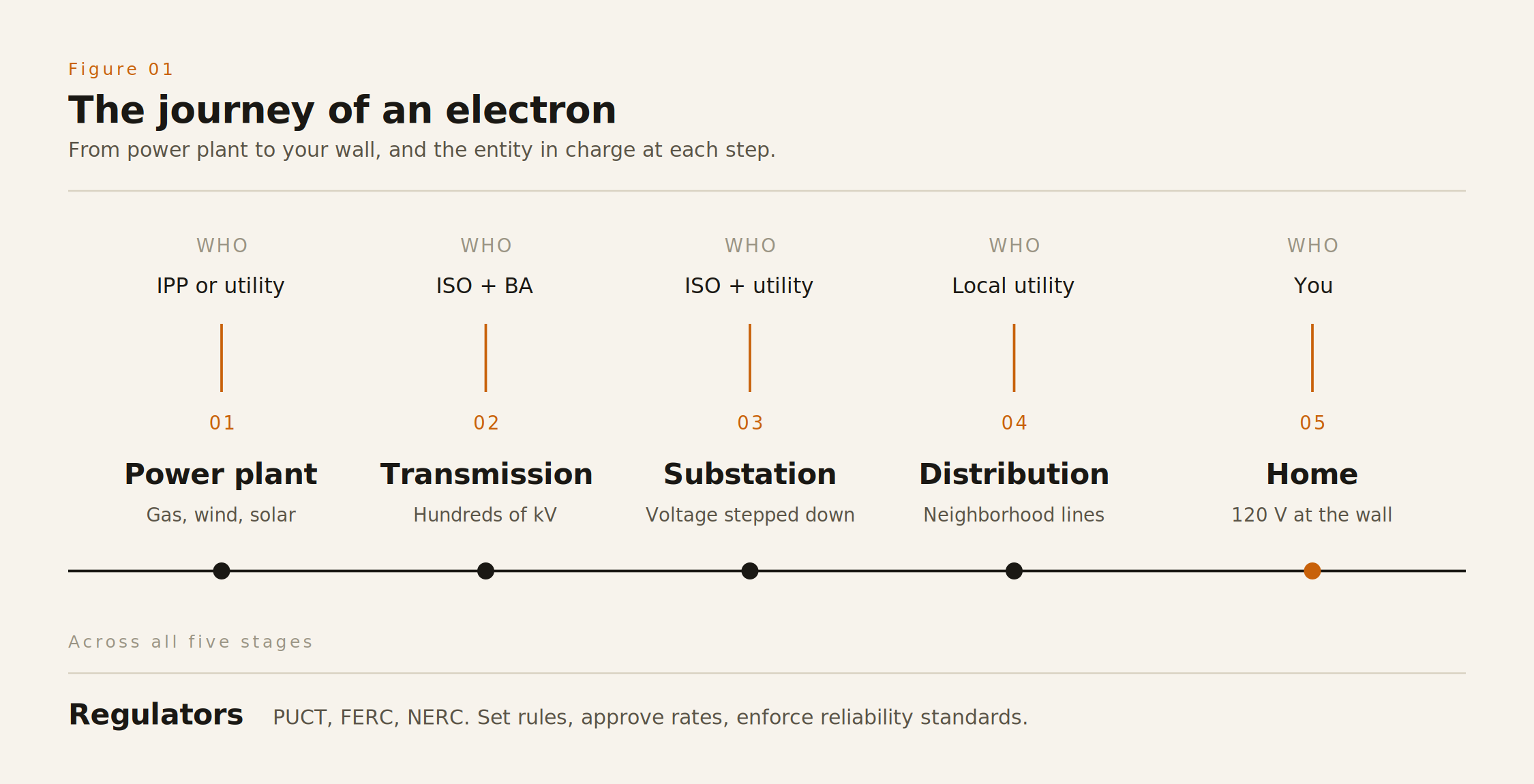 Caption: The physical path, with the entity in charge at each step.
The cast of characters
There are five roles worth knowing. Some of them might be played by the same company in your region, and some are played by different ones. That overlap is exactly what makes this confusing, so let’s separate the roles from the companies first.
The balancing authority keeps supply and demand matched in real time. This is the job with the tightest deadline. Frequency on the grid needs to stay near 60 hertz, and if generation and consumption drift apart by even a small amount, frequency drifts too. A balancing authority watches this on a screen and dispatches corrections within seconds.
The ISO (Independent System Operator) is a bigger role. It operates the bulk transmission system across a whole region, runs the electricity markets where generators sell power, and usually acts as the balancing authority for its footprint. “Independent” means it’s not owned by any one utility or generator. It’s supposed to treat everyone fairly.
You’ll sometimes see the term RTO (Regional Transmission Organization). An RTO is basically an ISO with expanded responsibility for long-term regional transmission planning and cost allocation across a larger footprint. FERC created the RTO designation in 1999 to push for bigger, more integrated regions. PJM, MISO, SPP, and ISO-NE are RTOs; CAISO, NYISO, and ERCOT are ISOs. For a reader’s purposes, they do the same job in the control room, so the rest of this post just says “ISO.”
The utility is the company that most people think of as “the electric company.” It owns wires and poles, delivers power to your house, sends you a bill, and shows up in a bucket truck after a storm. Depending on where you live, your utility might also own power plants and transmission lines, or just the local distribution network.
The independent power producer (IPP) owns power plants and sells electricity. A wind farm developer, a solar company, a gas plant operator. These are IPPs. They don’t run the grid or serve customers; they just produce.
The regulator writes and enforces the rules. In the US, state regulators (like the Public Utility Commission of Texas) oversee retail rates and local utilities. Federal regulators (like FERC) oversee interstate transmission and wholesale markets. They don’t operate anything. They keep everyone else honest.
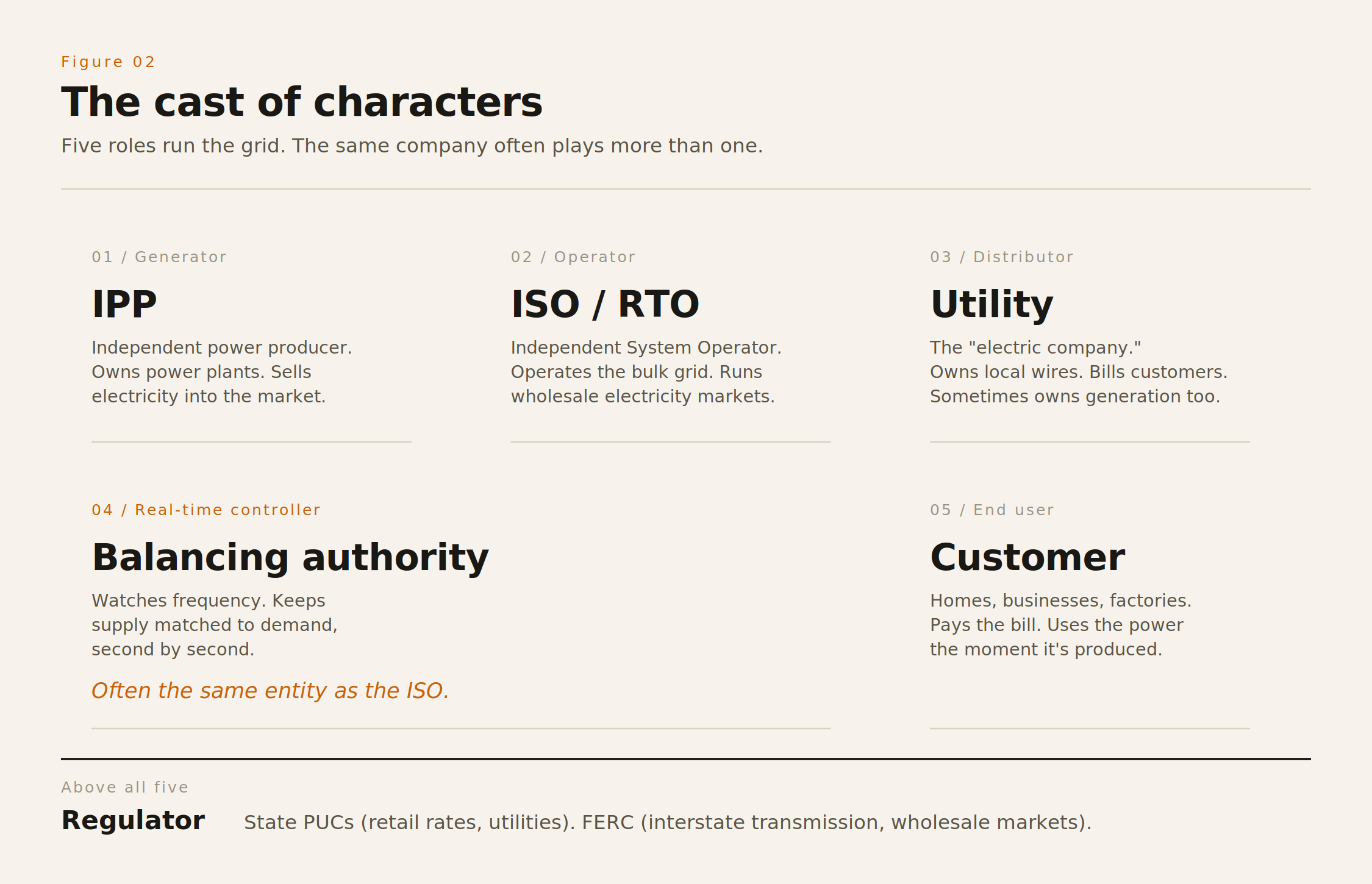 Caption: The five roles, and how they connect.
How they work together: think of it like a restaurant
The cast list is a lot to hold in your head at once. Here’s an analogy that helps.
Imagine a huge restaurant that has to serve exactly the right amount of food at exactly the right time, with no leftovers and no shortages, because the food can’t be stored. Every plate has to leave the kitchen the instant a customer wants it.
The farmers grow the ingredients. They don’t work in the restaurant. They just supply it. These are your power plants, owned by IPPs or utility generation arms.
The head chef runs the kitchen. She decides which farmers to buy from tonight (the cheapest ones that can deliver on time), tells each station when to start cooking, and watches the pass to make sure plates go out the door at the right pace. This is your ISO. It runs the overnight auction that picks which plants run tomorrow, dispatches them through the day, and coordinates the whole bulk system.
The expeditor stands at the pass with a stopwatch. If the dining room suddenly gets busier, she yells at the line to push more plates out, right now. If it slows down, she tells them to ease off. Her whole job is keeping the pace matched to the room, second by second. This is the balancing authority. In most big regions, the head chef and the expeditor are the same person wearing two hats. That’s why you’ll hear people say an ISO “is also” the balancing authority.
The waitstaff carry the food from the kitchen to the tables. They don’t cook, and they don’t pick the menu. They’re the last mile between the kitchen and the customer. This is your local utility, owning the distribution lines and the transformer outside your house.
The health inspector never cooks a single thing. She shows up to make sure the kitchen is clean, the prices on the menu are fair, and nobody is cutting corners on safety. She sets the rules that everyone else operates under. This is your regulator.
The same meal passed through four or five different people’s hands in the span of a few minutes. The grid works the same way, just faster and at a scale of millions of diners at once.
Now replay our electron through the restaurant. A farmer (the power plant) sends ingredients to the kitchen because the head chef (the ISO) called in an order last night based on tonight’s reservations. The head chef cooks the dish and hands it to the pass. The expeditor (the balancing authority), watching the dining room fill up faster than expected, tells the kitchen to fire two more tickets right now. The waitstaff (your local utility) carries the plate from the pass to your table. You (the customer) eat the food. You turn on the lamp.
And the whole time, the health inspector (the regulator) has already set the rules about how hot the food has to be, how fair the prices are, and what the kitchen has to do if the power goes out.
Why it looks different depending on where you live
The US doesn’t have one grid with one governance structure. It has three big interconnections (Eastern, Western, and Texas), and within those, a patchwork of regions with very different setups.
To stick with the restaurant analogy: in about two-thirds of the country, there’s a big central kitchen running the show. An ISO or RTO covers a whole region. PJM covers 13 states from Illinois to New Jersey. MISO covers the central Midwest. ERCOT covers most of Texas. CAISO covers most of California. NYISO, ISO-NE, and SPP cover New York, New England, and the central plains. In these regions, the ISO is the head chef and the expeditor. Utilities own the building and the waitstaff, but the kitchen isn’t theirs to run.
In the rest of the country, much of the Southeast, much of the non-California West, and Alaska, there’s no ISO. Each big utility runs its own kitchen, for its own dining room, with its own waitstaff. Southern Company does it in Georgia and Alabama. Duke Energy does it in the Carolinas. PacifiCorp does it across parts of the West. These are “vertically integrated” utilities. They own the farms, the kitchen, and the waitstaff. There’s no outside auction picking the cheapest farmer. The utility runs the whole operation and charges customers a regulated rate to cover the costs.
And then there are hybrids. Utilities that participate in shared markets without being in a full ISO, regions that are partially integrated. The map is messier than a textbook would suggest.
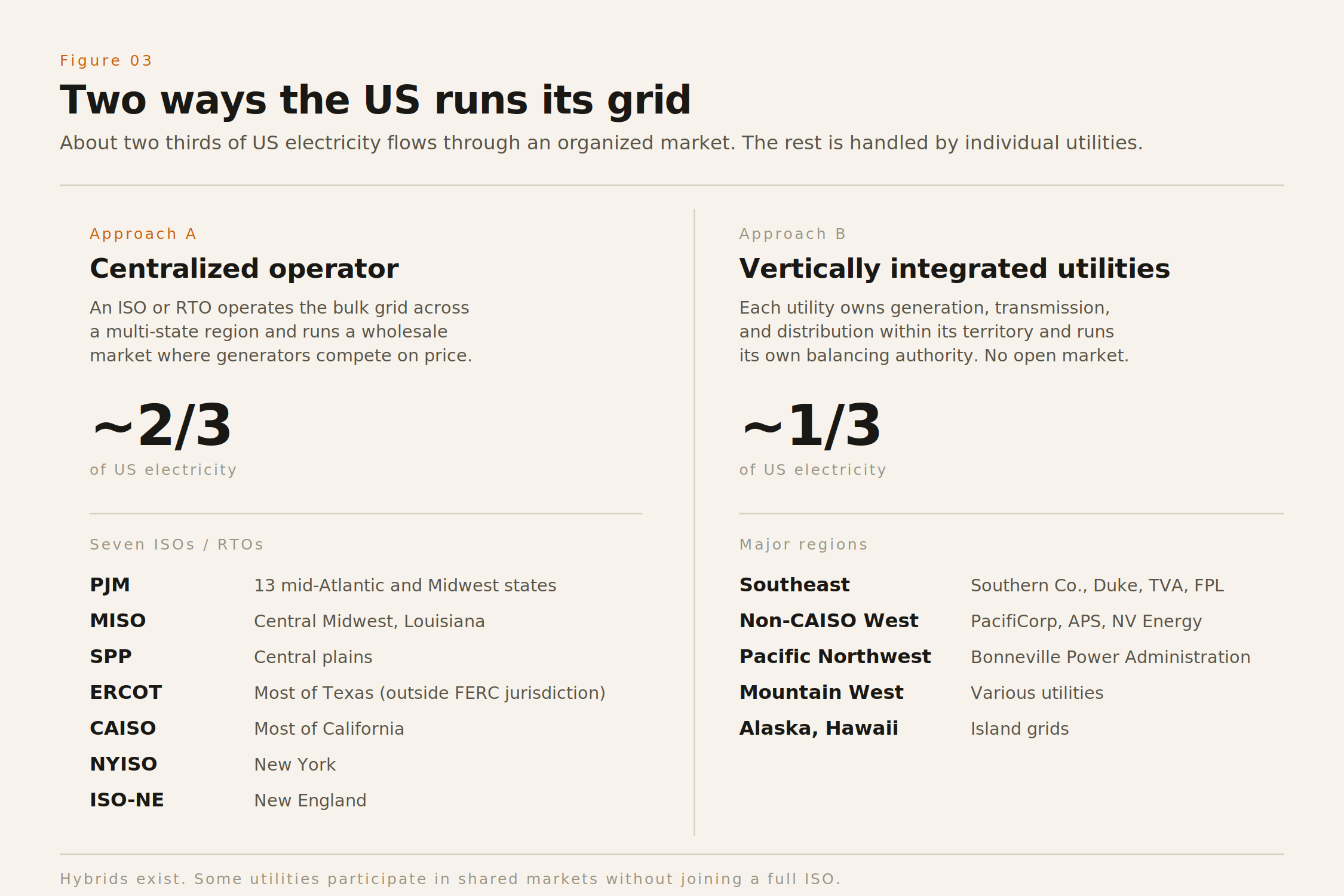 Caption: A schematic of how grid operation is divided across the US. Not drawn to geographic scale.
Who’s who, by region
Here’s a cheat sheet. Find your region and you can see how the pieces fit.
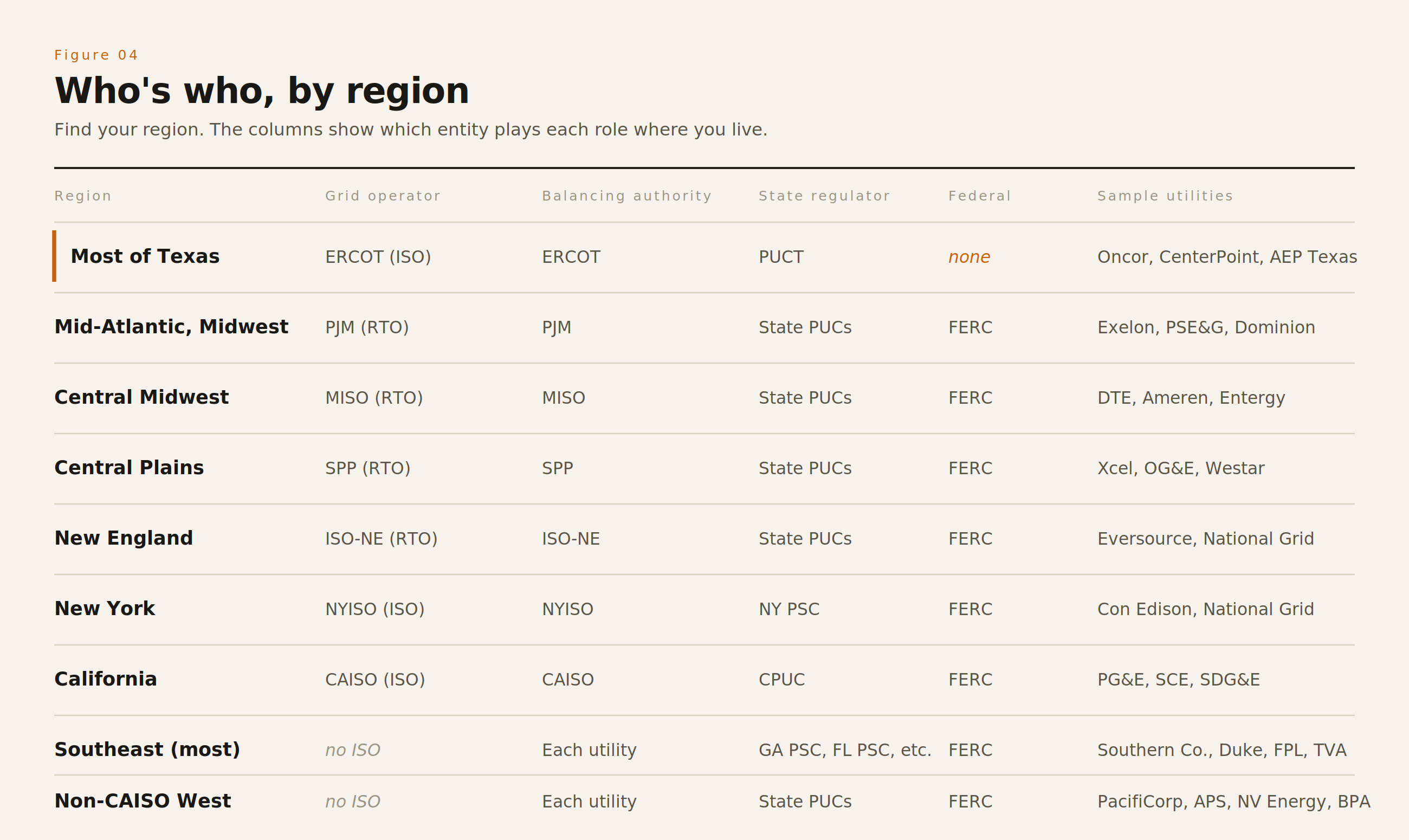 Caption: Who’s who, by region.
A few things worth pointing out from the table.
The regulator column tells you a lot. Notice that Texas is the only row with no federal regulator. That’s the ERCOT quirk: because it doesn’t cross state lines in a way that triggers FERC authority, PUCT has wholesale market oversight that state regulators elsewhere don’t. Every other state PUC handles retail rates and utility oversight, while FERC handles wholesale.
The balancing authority column is where the ISO-vs-utility split shows up cleanly. In ISO regions, the ISO is the BA. In non-ISO regions, each big utility runs its own. There are roughly 60 balancing authorities in North America, and most of them are utilities in those bottom two rows.
Utilities appear in every row, because utilities own the local wires and serve customers everywhere. What changes is how much else they do. In the Southeast and non-CAISO West, those utility names own the generation and operate the grid too. In ISO regions, they’re mostly confined to the wires-and-customers role.
Texas is its own thing
Since we started with a gas plant in central Texas, a word about ERCOT, because it’s unusual.
ERCOT operates the grid for about 90% of Texas. What makes it distinctive is that it deliberately doesn’t connect meaningfully to the rest of the country, which means it stays out of federal jurisdiction. In most of the US, FERC regulates the wholesale electricity market. In Texas, the Public Utility Commission of Texas (PUCT) does that job instead.
PUCT wears several hats. It regulates the wires companies like Oncor and CenterPoint (setting their rates, approving new transmission lines). It regulates the retail electricity providers that Texans buy power from in the deregulated market. And it oversees ERCOT itself, the reliability policies, market design, and resource adequacy rules. After Winter Storm Uri in 2021, PUCT was the body directing ERCOT to change how the market handles extreme weather.
Every state has an equivalent body. California has the CPUC. New York has the NY PSC. Florida has the FPSC. What varies is how much authority each one has over the wholesale market: huge in Texas, modest elsewhere, because FERC handles that in the other 49 states.
The bigger picture
If you zoom out, the whole system is really one ongoing negotiation between three timescales. Right now, operators are balancing generation and demand second by second. Over hours and days, markets are pricing electricity and scheduling plants. Over years and decades, regulators are approving transmission lines and setting the rules that shape what the grid looks like a generation from now.
The electron that lit your lamp traveled through all three timescales before it got to you. The generator that produced it exists because of a decade-old planning decision. The market that dispatched it ran an auction last night. The balancing authority adjusted its output a second ago. The utility delivered it through a pole transformer that was installed in the 1990s.
That’s the grid. Not wires and generators, but a choreography of people and institutions, all coordinating to keep the lights on.